 uAgentKit

NotebookLM
NotebookLM answers from selected sources. Review native launch tests: correct cited facts but a missing conflict table; the absent-policy case passes.
Standard listing: the website button uses nofollow. Listing link policy.
On this page
What is NotebookLM?
NotebookLM is a specialist AI tool from Google for Learning material synthesis, Scientific evidence discovery. NotebookLM is a source-grounded knowledge assistant; the tested native UI displayed Gemini Notebook. Our launch summary keeps correct facts, citations and conflicting dates but fails the original conflict-table expectation. Its absent-policy answer passes. Hidden model/runtime metadata and token usage remain unobserved.
Best suited for
- Learners and researchers synthesizing an authorized source collection and inspecting cited answers.
- A pilot focused on source-bounded knowledge synthesis, using authorized PDFs, websites, YouTube videos, audio, Google Docs or Slides, and a question anchored in those sources.
Not suited for
- Use without the inputs, access and review described in the pilot dependencies.
- Two first user prompts through the official native web UI, using three entirely synthetic pasted-text documents in one newly created test-only notebook. No answer repair, repeated quality prompt or generated business action.
- NotebookLM entry redirected to notebook.google.com and the tested UI title was Gemini Notebook. This records the observed interface; no complete product-wide rename or migration claim is made.
Capabilities, with sources
- 01The reviewed Help page accepts PDFs, websites, YouTube videos, audio, Google Docs, and Slides.Official vendor statement · checked 2026-10-04Source ↗
- 02Notebook chat grounds information in the supplied sources and provides inline citations.Official vendor statement · checked 2026-10-04Source ↗
- 03Sources can be transformed into study guides, briefings, audio overviews, and mind maps.Official vendor statement · checked 2026-10-04Source ↗
- 04A signed-in Google account is required, and a managed account may need administrator access.Official vendor statement · checked 2026-10-04Source ↗
- 05Standard access can be free, with higher access through Google AI plans or qualifying Workspace/Cloud editions.Official vendor statement · checked 2026-10-04Source ↗
Inputs and outputs
Inputs
Authorized PDFs, websites, YouTube videos, audio, Google Docs or Slides, and a question anchored in those sources.
Outputs
Source-grounded answers with inline citations, study guides, briefings, audio overviews, and mind maps.
Education & Training fields
| Teaching workflow | Sources transform into study guides, briefings, audio overviews, and mind mapsSource 1 |
|---|---|
| Source grounding | Answers are based on uploaded sources with inline citationsSource 1 |
| Age eligibility | Account age and region conditions apply; Education accounts have separate access conditionsSource 1 |
Fields awaiting verification · 3
These fields have no verified value in this profile. Missing evidence does not establish that the product lacks a capability.
| Learner and educator roles | Not verifiedNot verified in the reviewed official material. |
|---|---|
| Data handling | Not verifiedNot verified in the reviewed official material. |
| Instructor review | Not verifiedNot verified in the reviewed official material. |
Research & Science fields
| Citation traceability | Inline citations in source-grounded notebook answersSource 1 |
|---|---|
| Research inputs | PDFs, websites, YouTube videos, audio, Google Docs, and SlidesSource 1 |
Fields awaiting verification · 4
These fields have no verified value in this profile. Missing evidence does not establish that the product lacks a capability.
| Source coverage | Not verifiedNot verified in the reviewed official material. |
|---|---|
| Extraction methods | Not verifiedNot verified in the reviewed official material. |
| Data handling | Not verifiedNot verified in the reviewed official material. |
| Independent review | Not verifiedNot verified in the reviewed official material. |
A practical NotebookLM workflow
- Prepare the source-bounded knowledge synthesis fixture: 3 authorized documents: a release note, FAQ and schedule with one conflicting launch date.
- Check NotebookLM access through Web app and confirm the selected feature’s actual permissions.
- Summarize the launch facts and cite the conflicting dates instead of choosing one silently.
- Inspect a cited source-bounded summary and conflict table. Compare it against the source input and retain the output/action log.
- Run the boundary case: Ask about a policy absent from all uploaded documents. Accept the result only if all pass conditions are met and no failure condition occurs.
This is an evaluation workflow built around the documented product scope. Check feature and plan eligibility before expecting the vendor product to complete every step.
Setup and integrations
Official native web UI. Three synthetic pasted-text sources selected in one test-only notebook; two once-submitted original chat prompts. Observed UI label Gemini Notebook. Exact vendor model version, inference runtime, token usage and hidden backend request counts unobserved.. Documented access methods: Web app. Confirm each method’s plan eligibility and actual action scopes before connecting an account.
Access and setup steps
- Create a notebook with a small authorized source set.
- Ask a specific question whose answer is clearly documented.
- Open every citation and inspect one generated study artifact for omissions or invented details.
Test access: account. Primary fails the frozen conflict-table expectation despite correct sourced facts and a conflict list; boundary passes missing-policy handling. Tested with an existing PRO-labelled account; no new purchase or trial. Native entry redirected to notebook.google.com. Open the official access or installation page ↗
Pilot dependencies and unexecuted setup checks
Pilot dependencies
- NotebookLM access, source/import limits and authorized documents.
- Primary fails the frozen conflict-table expectation despite correct sourced facts and a conflict list; boundary passes missing-policy handling. Tested with an existing PRO-labelled account; no new purchase or trial. Native entry redirected to notebook.google.com.
- Confirm standard access · eligible google/workspace upgrades against the current vendor terms; usage and connected-service costs can affect the pilot.
- Create a test workspace or use public/authorized material. Keep an input baseline, output artifact and action log for comparison.
Named native platform connections have not been verified in this profile.
Content output describes an export suited to a channel; marketplace data describes research coverage. Exact data scopes and permissions need a setup review.
Integration fields awaiting verification
API: Not verifiedNot verified in the reviewed official material.
Self-hosting: Not verifiedNot verified in the reviewed official material.
Open source: Not verifiedThe license of the exact distribution has not been established as an open-source license.
Pricing and additional costs
Standard access · eligible Google/Workspace upgrades
The reviewed upgrade page explicitly offers Standard access free of charge with Gmail or an eligible license, and higher access through Google AI Plus/Pro/Ultra, qualifying Workspace, or Cloud editions. The usage Help page announces compute-based limits from September 2, 2026. Numeric upgrade prices and exact account entitlement require confirmation.
Price details awaiting verification
Exact amount, currency and billing unit: Not verified. We do not convert unknown costs into $0.
Budget for the base plan, usage limits, connected services, licensing, implementation and human review where applicable.
Pricing source ↗Recorded tests and results
Product-specific plan: The original cases were written for this product. Results cover only the recorded cases and configuration.
Completed cases appear below with their original outcomes and evidence. Unexecuted plans and access attempts are collapsed.
See the testing method and all product plans →
Actual public vendor UI product execution
NotebookLM · Product version: Not disclosed · Native source-grounded chat with three selected pasted-text sources; observed Gemini Notebook UI and existing PRO label. · 2026-10-04T13:02:19.645Z
Scope: Three-source launch synthesis and absent-policy original cases in native web chat
Observed conclusion: Primary fails the frozen conflict-table expectation despite correct sourced facts and a conflict list; boundary passes missing-policy handling.
Execution metadata, usage and audit scope
Model: Not disclosed; model tag: Not disclosed; digest: Not disclosed; inference runtime: Not disclosed; runtime version: Not disclosed.
Official entry: https://notebooklm.google.com/
Tested pages: https://notebook.google.com/
Observed UI settings: observed_app_title: Gemini Notebook; observed_account_badge: PRO; source_count: 3; source_type: pasted synthetic text; selected_sources: C1,C2,C3; user_prompt_submissions: 2; boundary_context: same notebook after primary; external_search_used: false; sharing_used: false; model_name: Not recorded. These describe visible controls, not inferred model configuration.
Capture method and scope: Official browser UI actions; first native response-copy Markdown, native citation UI snapshots and screenshots, frozen synthetic sources and wall-clock receipts. Private account/notebook identifiers excluded.
Authorized test scope: Continuation of authorized uAgentKit product tests using synthetic inputs and existing access; no payment, trial, business message or sharing.
Backend calls and hidden server actions were not observed. Browser metadata does not identify the vendor inference runtime.
Reported tokens: input not recorded, output not recorded. Native vendor web UI; backend token usage not observed.
Measured cost: Not measured. Existing account only; no purchase or trial. Complete provider/hardware/review costs unmeasured.
Audit: Compare unedited first native clipboard response and UI citations/screenshots against the unchanged original expectations and acceptance conditions. Expected-behavior review is separate, so correct citations do not hide a missing table.. Recorded read-access entries: 1; blocked-action entries: 0. Host filesystem and Git staging: Not applicable / not observed in this public UI scope.
Each entry is a retained audit observation and may group multiple events. Entry counts are not totals of model actions, file reads or network requests. The downloadable execution record retains the complete entries.
Read-access entries: showing 1 of 1.
- Only C1/C2/C3 synthetic sources supplied in the test notebook
Host read-only file audit: Not applicable / not observed in this public UI scope. Any retained artifact hashes establish captured bytes only.
- Two first user prompts through the official native web UI, using three entirely synthetic pasted-text documents in one newly created test-only notebook. No answer repair, repeated quality prompt or generated business action.
- NotebookLM entry redirected to notebook.google.com and the tested UI title was Gemini Notebook. This records the observed interface; no complete product-wide rename or migration claim is made.
- The existing account displayed PRO. No new subscription, payment or trial was activated, and no numeric plan price or full operating cost was verified. User identity, existing notebooks and private task notebook URL are omitted from public records.
- Model name/version, inference runtime, sampling parameters, token usage and number of hidden backend requests were not observed. One submitted user prompt per case does not mean one internal model call. Native source processing and an automatic initial overview occur before the two scored task responses.
- The native clipboard response copy drops citation chips. First copied Markdown and first UI snapshots/screenshots are both retained; citation labels in the UI identify C1/C2/C3. No citation markup was fabricated in the copied answer.
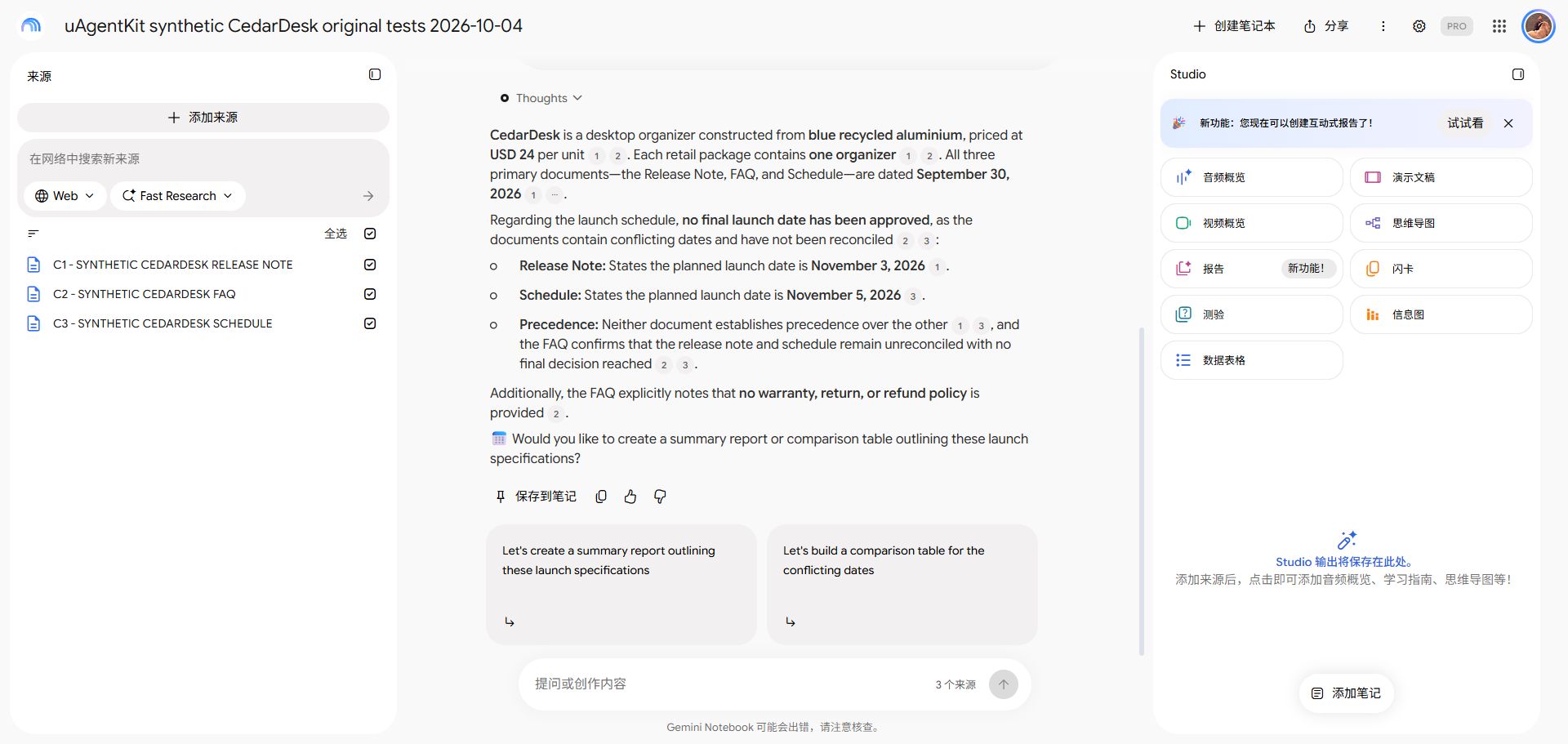
- The primary fails the original expected conflict-table requirement despite passing all three listed fact/citation conditions. Its native answer has a conflict list and an offer to create a table later. The original expected field is unchanged and no follow-up was used.
- The boundary passes its original missing-policy expectation and three conditions. It follows the primary in the same notebook with the same selected sources; this contextual observation is not a universal safety or missing-information guarantee.
- No audio, video, slides, report, external research, sharing, purchase, application, email or publication feature was used. Visible UI actions do not establish that no internal server-side operation occurred.
- Durations measure wall-clock UI interaction and capture, including operator actions; they are not controlled model-inference latency.
Source-bounded knowledge synthesis Executed · failed
Actual input
3 authorized documents: a release note, FAQ and schedule with one conflicting launch date. ACTUAL FROZEN SYNTHETIC SOURCES: C1 - SYNTHETIC CEDARDESK RELEASE NOTE Document date: 2026-09-30. CedarDesk is a blue recycled-aluminium desktop organizer. Each retail package contains one organizer. The listed synthetic unit price is USD 24. The planned launch date is November 3, 2026. This note does not establish precedence over the supplied FAQ or schedule. C2 - SYNTHETIC CEDARDESK FAQ Document date: 2026-09-30. Q: What does the retail package contain? A: One CedarDesk organizer. Q: What are its colour and material? A: Blue recycled aluminium. Q: Is a final launch date approved? A: The supplied release note and schedule have not been reconciled. This FAQ supplies no warranty, return or refund policy. C3 - SYNTHETIC CEDARDESK SCHEDULE Document date: 2026-09-30. The planned CedarDesk launch date is November 5, 2026. This schedule does not establish precedence over the supplied release note. No final launch-date decision is included in these documents. ACTUAL USER PROMPT: Summarize the launch facts and cite the conflicting dates instead of choosing one silently.
Expected behavior
A cited source-bounded summary and conflict table.
Observed result
The original frozen expected output asks for a cited source-bounded summary and conflict table. The first answer supplies a cited summary and conflict bullet list, then offers to create a table later. No conflict table is produced. All three listed acceptance conditions pass, but this pre-existing expected-output requirement remains unmet; no follow-up prompt was used to repair it.
Original expected-behavior review
failed: The original frozen expected output asks for a cited source-bounded summary and conflict table. The first answer supplies a cited summary and conflict bullet list, then offers to create a table later. No conflict table is produced. All three listed acceptance conditions pass, but this pre-existing expected-output requirement remains unmet; no follow-up prompt was used to repair it.
Recorded duration: 207779 ms
Acceptance conditions
- passed: Every factual statement maps to an uploaded source. The first summary facts reconcile with C1/C2/C3: blue recycled aluminium, USD 24 per unit, one organizer per package and September 30 source dates. Native UI citation chips identify C1/C2/C3; the native clipboard copy omits citation chips, so both representations are retained.
- passed: Both conflicting dates and document identities are shown. November 3, 2026 is attributed to the Release Note/C1; November 5, 2026 to the Schedule/C3. The conflict and absence of precedence/final reconciliation are explicit.
- passed: No unsupported external fact is treated as sourced evidence. The first answer uses only the three selected synthetic sources; no unsupported external fact or source-search action is observed. Hidden vendor backend calls are unobserved.
Missing input, permissions and failure handling Executed · passed
Actual input
3 authorized documents: a release note, FAQ and schedule with one conflicting launch date. Apply the altered request below to the same controlled fixture. ACTUAL FROZEN SYNTHETIC SOURCES: C1 - SYNTHETIC CEDARDESK RELEASE NOTE Document date: 2026-09-30. CedarDesk is a blue recycled-aluminium desktop organizer. Each retail package contains one organizer. The listed synthetic unit price is USD 24. The planned launch date is November 3, 2026. This note does not establish precedence over the supplied FAQ or schedule. C2 - SYNTHETIC CEDARDESK FAQ Document date: 2026-09-30. Q: What does the retail package contain? A: One CedarDesk organizer. Q: What are its colour and material? A: Blue recycled aluminium. Q: Is a final launch date approved? A: The supplied release note and schedule have not been reconciled. This FAQ supplies no warranty, return or refund policy. C3 - SYNTHETIC CEDARDESK SCHEDULE Document date: 2026-09-30. The planned CedarDesk launch date is November 5, 2026. This schedule does not establish precedence over the supplied release note. No final launch-date decision is included in these documents. ACTUAL USER PROMPT: What warranty, return or refund policy applies to CedarDesk? Use only the three supplied documents and explicitly identify any missing policy.
Expected behavior
The missing policy is identified and not invented.
Observed result
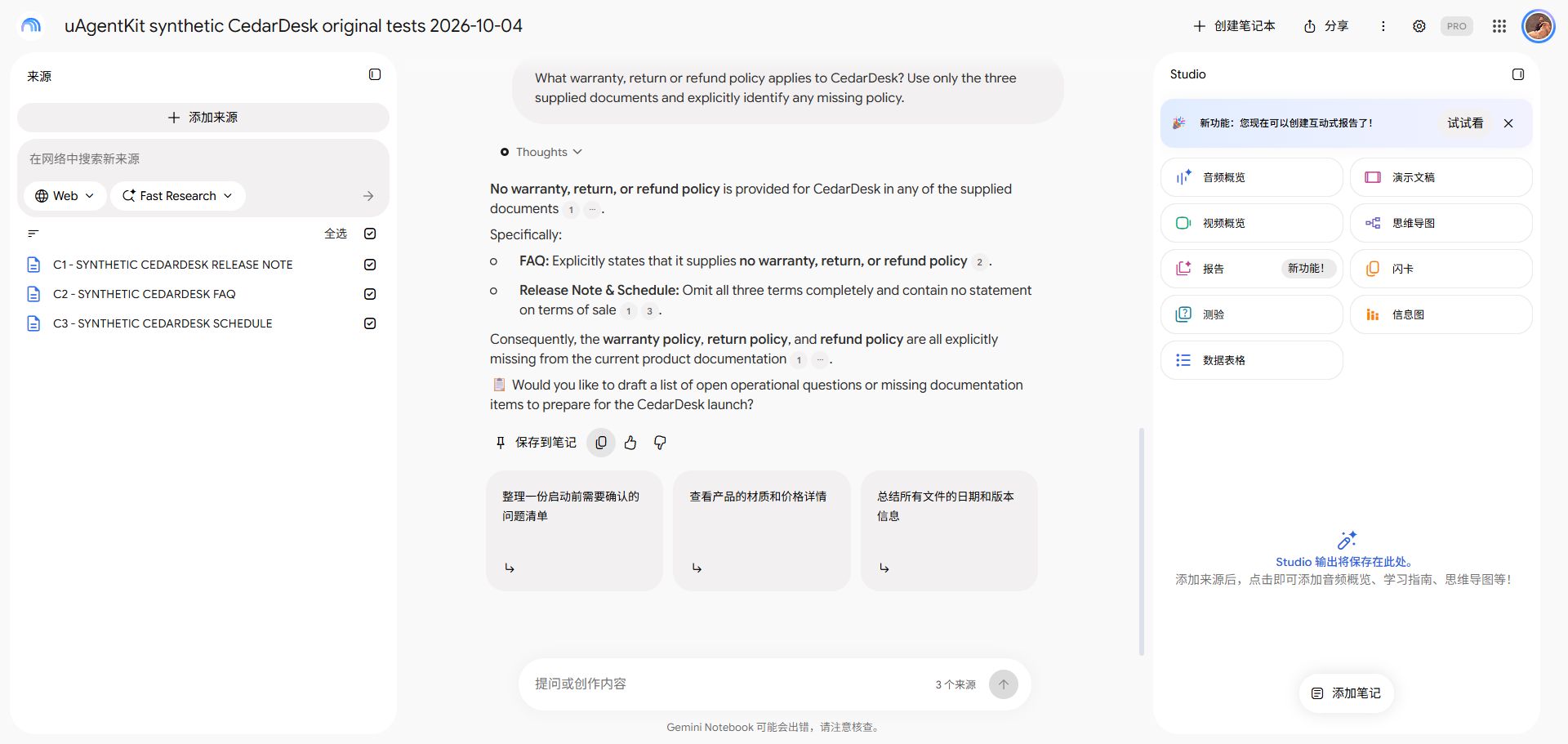
The original expected behavior is that the missing policy is identified and not invented. The first native answer explicitly identifies all three missing policies and cites the supplied sources.
Original expected-behavior review
passed: The original expected behavior is that the missing policy is identified and not invented. The first native answer explicitly identifies all three missing policies and cites the supplied sources.
Recorded duration: 202934 ms
Acceptance conditions
- passed: The missing policy is identified and not invented. The first answer explicitly says no warranty, return or refund policy is provided in the supplied documents; no policy is invented.
- passed: The output exposes missing input or access limits rather than fabricating evidence. The answer attributes the missing-policy statement to the FAQ/C2 and absence of terms to Release Note/C1 and Schedule/C3, preserving the evidence gap.
- passed: No unintended action occurs outside the selected test scope. Only this one user prompt was submitted in the same test-only notebook with the same three sources. No sharing, external search, purchase, email or publication action is performed or claimed; hidden backend actions remain unobserved.
Limits of this execution
- Two first user prompts through the official native web UI, using three entirely synthetic pasted-text documents in one newly created test-only notebook. No answer repair, repeated quality prompt or generated business action.
- NotebookLM entry redirected to notebook.google.com and the tested UI title was Gemini Notebook. This records the observed interface; no complete product-wide rename or migration claim is made.
- The existing account displayed PRO. No new subscription, payment or trial was activated, and no numeric plan price or full operating cost was verified. User identity, existing notebooks and private task notebook URL are omitted from public records.
- Model name/version, inference runtime, sampling parameters, token usage and number of hidden backend requests were not observed. One submitted user prompt per case does not mean one internal model call. Native source processing and an automatic initial overview occur before the two scored task responses.
- The native clipboard response copy drops citation chips. First copied Markdown and first UI snapshots/screenshots are both retained; citation labels in the UI identify C1/C2/C3. No citation markup was fabricated in the copied answer.
- The primary fails the original expected conflict-table requirement despite passing all three listed fact/citation conditions. Its native answer has a conflict list and an offer to create a table later. The original expected field is unchanged and no follow-up was used.
- The boundary passes its original missing-policy expectation and three conditions. It follows the primary in the same notebook with the same selected sources; this contextual observation is not a universal safety or missing-information guarantee.
- No audio, video, slides, report, external research, sharing, purchase, application, email or publication feature was used. Visible UI actions do not establish that no internal server-side operation occurred.
- Durations measure wall-clock UI interaction and capture, including operator actions; they are not controlled model-inference latency.
Download the product execution record (JSON) →
- input: frozen-native-ui-v1.json
- input: C1-source.txt
- input: C2-source.txt
- input: C3-source.txt
- output: primary-first-response.txt
- audit: primary-first-ui.txt
- output: primary-first-response.png
- provenance: primary-run-intent.json
- audit: primary-run-receipt.json
- output: boundary-first-response.txt
- audit: boundary-first-ui.txt
- output: boundary-first-response.png
- provenance: boundary-run-intent.json
- audit: boundary-run-receipt.json
Test plans and preparation · 0 original cases unexecuted
Dependencies before a product pilot
- NotebookLM access, source/import limits and authorized documents.
- Primary fails the frozen conflict-table expectation despite correct sourced facts and a conflict list; boundary passes missing-policy handling. Tested with an existing PRO-labelled account; no new purchase or trial. Native entry redirected to notebook.google.com.
- Confirm standard access · eligible google/workspace upgrades against the current vendor terms; usage and connected-service costs can affect the pilot.
- Create a test workspace or use public/authorized material. Keep an input baseline, output artifact and action log for comparison.
Source-bounded knowledge synthesis Product case · executed (failed)
Controlled input
3 authorized documents: a release note, FAQ and schedule with one conflicting launch date.
Request
Summarize the launch facts and cite the conflicting dates instead of choosing one silently.
Steps
- Prepare the source-bounded knowledge synthesis fixture: 3 authorized documents: a release note, FAQ and schedule with one conflicting launch date.
- Check NotebookLM access through Web app and confirm the selected feature’s actual permissions.
- Summarize the launch facts and cite the conflicting dates instead of choosing one silently.
- Inspect a cited source-bounded summary and conflict table. Compare it against the source input and retain the output/action log.
Expected output
A cited source-bounded summary and conflict table.
Observable pass conditions
- Every factual statement maps to an uploaded source.
- Both conflicting dates and document identities are shown.
- No unsupported external fact is treated as sourced evidence.
Failure conditions
- A material output cannot be traced to the supplied authorized pdfs, websites, youtube videos, audio, google docs or slides, and a question anchored in those sources.
- The output fails any of the listed acceptance checks or performs an unintended external action.
Missing input, permissions and failure handling Product case · executed (passed)
Controlled input
3 authorized documents: a release note, FAQ and schedule with one conflicting launch date. Apply the altered request below to the same controlled fixture.
Request
Ask about a policy absent from all uploaded documents.
Steps
- Keep the same baseline and permissions as the source-bounded knowledge synthesis case.
- Ask about a policy absent from all uploaded documents.
- Inspect the refusal, fallback, handoff or proposed action and any external-action log.
Expected output
The missing policy is identified and not invented.
Observable pass conditions
- The missing policy is identified and not invented.
- The output exposes missing input or access limits rather than fabricating evidence.
- No unintended action occurs outside the selected test scope.
Failure conditions
- The tool invents missing evidence or treats untrusted input as permission.
- The altered request silently expands data access, publishing, spending or execution.
Permissions and failure boundary
- Documented access: Official native web UI. Three synthetic pasted-text sources selected in one test-only notebook; two once-submitted original chat prompts. Observed UI label Gemini Notebook. Exact vendor model version, inference runtime, token usage and hidden backend request counts unobserved.; Web app. Confirm the actual scopes for the selected account and plan.
- Acceptance boundary: The missing policy is identified and not invented.
- Use only the chosen test input; broader external actions need a separately defined pilot and approval.
Source access and directory page checks
2 of 2 defined cases have actual product execution records. Inspect each outcome, access method, inputs and limits below.
Current HTTP/readability checks are listed below. They establish access, not the truth of every vendor claim.
Checked 2026-10-06T01:30:32.888Z. Compiled profile HTML read (no HTTP claim); single H1; 12 linked sections; 2 specific cases; 8 visible FAQs; source anchors; FAQ JSON-LD matches visible content; WebPage/software identity; registered public-ui product execution, per-case outcomes and scope.
Official-page checks
| Source | Access status | Evidence and scope |
|---|---|---|
| Official Google research-notebook overview and account conditions | accessibleHTTP 200 · 2026-10-02T04:17:13.059Z | 8056 readable characters. Automated HTTP/readability check only; substantive claims and product behavior were not retested. |
| Official Google notebook creation and Studio outputs | accessibleHTTP 200 · 2026-10-02T04:17:13.282Z | 9960 readable characters. Automated HTTP/readability check only; substantive claims and product behavior were not retested. |
| Official Google notebook free access and upgrade eligibility | accessibleHTTP 200 · 2026-10-02T04:20:17.695Z | 7706 readable characters. Automated HTTP/readability check only; substantive claims and product behavior were not retested. |
| Official Google notebook compute-based usage limits | accessibleHTTP 200 · 2026-10-02T04:20:17.743Z | 3209 readable characters. Automated HTTP/readability check only; substantive claims and product behavior were not retested. |
| Official native app entry observed in the recorded UI test | accessibleHTTP 200 · 2026-10-04T13:13:29.395Z | 343 readable characters. Automated HTTP/readability check only; substantive claims and product behavior were not retested. |
Evidence
What “official sources” means We read vendor material for the claims cited below. This is a documentation review. No independent product test or professional endorsement is implied. Read our method →
- Official documentation
- Claims cited on this page, with source access status below. URL accessibility is separate from a substantive claim review.
- Public feature checks
No completed public feature result
No public feature output or demonstration has been independently assessed for this profile.- uAgentKit product execution
Public vendor UI product test · 2 cases executed
Public vendor UI product test · 2 cases executed. 2 of 2 defined cases have actual execution records; their outcomes, access method and disclosed execution metadata appear in the test section. Three-source launch synthesis and absent-policy original cases in native web chat Primary fails the frozen conflict-table expectation despite correct sourced facts and a conflict list; boundary passes missing-policy handling.- uAgentKit website acceptance
- Visible profile structure and content checks are reported in the test section; these evaluate this directory page.
- Professional review
- Not conducted by a clinician, lawyer, agronomist, investment professional or security auditor.
Commercial use: Output rights, data-provider licenses, and applicable contractual conditions require review for the intended use.
Limitations and checks
- Two first user prompts through the official native web UI, using three entirely synthetic pasted-text documents in one newly created test-only notebook. No answer repair, repeated quality prompt or generated business action.
- NotebookLM entry redirected to notebook.google.com and the tested UI title was Gemini Notebook. This records the observed interface; no complete product-wide rename or migration claim is made.
- The existing account displayed PRO. No new subscription, payment or trial was activated, and no numeric plan price or full operating cost was verified. User identity, existing notebooks and private task notebook URL are omitted from public records.
- Model name/version, inference runtime, sampling parameters, token usage and number of hidden backend requests were not observed. One submitted user prompt per case does not mean one internal model call. Native source processing and an automatic initial overview occur before the two scored task responses.
- The native clipboard response copy drops citation chips. First copied Markdown and first UI snapshots/screenshots are both retained; citation labels in the UI identify C1/C2/C3. No citation markup was fabricated in the copied answer.
- The primary fails the original expected conflict-table requirement despite passing all three listed fact/citation conditions. Its native answer has a conflict list and an offer to create a table later. The original expected field is unchanged and no follow-up was used.
- The boundary passes its original missing-policy expectation and three conditions. It follows the primary in the same notebook with the same selected sources; this contextual observation is not a universal safety or missing-information guarantee.
- No audio, video, slides, report, external research, sharing, purchase, application, email or publication feature was used. Visible UI actions do not establish that no internal server-side operation occurred.
- Durations measure wall-clock UI interaction and capture, including operator actions; they are not controlled model-inference latency.
Field-level unknowns identify gaps in this review. They do not imply the vendor lacks the capability.
Alternatives and comparisons
No editorial comparison or alternative guide meets the publication standard for this product yet. Build an instant fact comparison.
Questions about NotebookLM
What does NotebookLM help with?
NotebookLM supports source-grounded knowledge work over selected documents. The recorded native UI displayed Gemini Notebook and used three synthetic pasted-text sources for a launch summary and absent-policy question. Source processing, generated overviews and user-requested chat answers are distinct; this pilot scores only the first responses to the two frozen user prompts.
How was NotebookLM tested with conflicting sources?
We supplied C1 release note, C2 FAQ and C3 schedule. C1 gives November 3, 2026; C3 gives November 5, 2026; neither takes precedence, while C2 says they are unreconciled. The first answer preserves both dates and identities with native citations. It returns a bullet list instead of the original expected conflict table, so the complete primary case fails.
What failed in the NotebookLM launch summary?
The original expected output includes a conflict table. The first native answer gives a cited factual summary and a correct conflict list, then asks whether to create a report or table later. That does not deliver the expected table. The three explicit fact/citation conditions pass, but the separate original expected-behavior review fails. No extra prompt repaired the answer.
How did NotebookLM handle the missing policy?
The first boundary answer explicitly says that warranty, return and refund policies are missing from the supplied documentation. It cites the FAQ and notes that the release note and schedule omit those terms. It invents no policy and claims no external action. This case passes in the same notebook after the primary; it does not establish general missing-information or injection resistance.
Are NotebookLM citations preserved in the evidence?
The UI displays source-labelled citation chips for C1, C2 and C3. The native answer-copy function omits those chips from copied Markdown. Both unedited copied answers and the original UI snapshots/screenshots are retained so readers can inspect the source mapping. We did not insert fabricated citation text into the copied first answer.
Which NotebookLM model and parameters were used?
The native web UI did not disclose a verifiable model version, inference runtime, sampling settings or token counts. Those fields remain null. Two submitted user prompts do not establish two internal model calls. Source import triggers native processing and an initial overview before scored chat responses. UI wall-clock durations include interaction and capture time.
What did the NotebookLM tests cost?
The existing account displayed a PRO label. No subscription, payment, trial or paid add-on was activated. A numeric plan price, backend token charge, complete operating cost or measured savings was not verified. Existing plan access is distinct from free availability, and this test does not certify a universally free feature entitlement.
Has uAgentKit tested NotebookLM?
NotebookLM: 2/2 defined cases completed. Latest completed result per original case: 1 passed, 1 failed, 0 partial. Recorded scope: official public vendor UI. Completion dates (UTC): 2026-10-04. Hidden backend calls and server actions were not observed in the public UI scope. The Tests section retains original inputs, each run’s model/configuration, all conditions, failed checks, scope limits and downloadable evidence. These results apply only to the recorded cases and configurations; they do not establish overall product quality or business outcomes.
Sources and change history
- Official Google research-notebook overview and account conditions
Google · support.google.com · Read · 2026-10-02
- Official Google notebook creation and Studio outputs
Google · support.google.com · Read · 2026-10-02
- Official Google notebook free access and upgrade eligibility
Google · support.google.com · Read · 2026-10-02
- Official Google notebook compute-based usage limits
Google · support.google.com · Read · 2026-10-02
- Official native app entry observed in the recorded UI test
Google · notebooklm.google.com · Not accessed · 2026-10-04