Patsnap Patentability Grader
Patsnap's free Patentability Grader returned 59/100 and 0/100 in two screens. Both frozen cases failed; inspect citation links and missing-feature handling.
On this page
What is Patsnap Patentability Grader?
Patsnap Patentability Grader is a specialist AI tool from Patsnap for Patent prior-art search. Patsnap Patentability Grader is the officially embedded free two-step invention screen, separate from the full Eureka Novelty Search and FTO agents. Two first native synthetic screens returned 59/100 and 0/100. Neither complete frozen case passed: the ordinary screen lacks direct original-document links, and the boundary does not explicitly recognize the supplied missing feature before scoring. Each passed 5/6 listed conditions; vendor scores are separate from this test verdict.
Best suited for
- Researchers who want a preliminary source-linked screen of a clearly specified technical feature before commissioning a complete claim-based search.
- A pilot focused on synthetic bottle feature and traceable prior-art screening, using two synthetic bottle descriptions: one detachable sensor feature and one explicitly missing novel feature. Product and new-feature fields are separate native inputs.
Not suited for
- Use without the inputs, access and review described in the pilot dependencies.
- Results concern two synthetic public-UI cases, not all inventions, jurisdictions or the full Eureka service.
- Native progress shows DEMO SPEED controls; 1× was left unchanged. Progress counters and the advertised 90-second promise were not independently audited as backend activity.
Capabilities, with sources
- 01The official free-tools page links to a free Patentability Grader.Official vendor statement · checked 2026-10-05Source ↗
- 02The tool separates product/method description and new technical feature, and compares the top five patent documents.Official vendor statement · checked 2026-10-05Source ↗
- 03The native tool distinguishes its free screen from complete Novelty Search and Freedom-to-Operate reports.Official vendor statement · checked 2026-10-05Source ↗
Inputs and outputs
Inputs
Two synthetic bottle descriptions: one detachable sensor feature and one explicitly missing novel feature. Product and new-feature fields are separate native inputs.
Outputs
First free score, feature-level source passages, top patent candidates and qualified next-step suggestions; full Eureka reports and filing are separate workflows.
Patents & Intellectual Property fields
| Patent offices | Not verifiedNot verified in the reviewed official material. |
|---|---|
| Countries | Not verifiedNot verified in the reviewed official material. |
| Languages | Not verifiedNot verified in the reviewed official material. |
| Coverage period | Not verifiedNot verified in the reviewed official material. |
| Legal status data | Not verifiedNot verified in the reviewed official material. |
| Search method | Not verifiedNot verified in the reviewed official material. |
| Export formats | Not verifiedNot verified in the reviewed official material. |
Research & Science fields
| Source coverage | Not verifiedNot verified in the reviewed official material. |
|---|---|
| Citation traceability | Not verifiedNot verified in the reviewed official material. |
| Research inputs | Not verifiedNot verified in the reviewed official material. |
| Extraction methods | Not verifiedNot verified in the reviewed official material. |
| Data handling | Not verifiedNot verified in the reviewed official material. |
| Independent review | Not verifiedNot verified in the reviewed official material. |
A practical Patsnap Patentability Grader workflow
- Prepare the synthetic bottle feature and traceable prior-art screening fixture: Synthetic product description: A reusable insulated drinks bottle with a screw cap, a rechargeable battery, a temperature sensor in the cap and a small LED display that shows the measured liquid temperature. No real invention or unpublished customer information is supplied.
- Check Patsnap Patentability Grader access through Official web UI and confirm the selected feature’s actual permissions.
- Enter the product description once. In WHAT'S NEW enter: The cap includes a removable temperature-sensor cartridge; the cartridge can be detached before washing, and the display stays off when the cartridge is absent. Retain the first free grade and first prior-art references without editing, retries or upgrading.
- Inspect the first native screen completes or clearly reports a failure. A usable screening result identifies the supplied detachable sensor feature, displays a score with its basis, and includes actual resolvable patent identifiers with relevant supporting passages. Any recommendation remains a preliminary screen rather than a guarantee of novelty, grant or freedom to operate. Compare it against the source input and retain the output/action log.
- Run the boundary case: Enter the product description once. In WHAT'S NEW enter: No new technical feature has been supplied. I do not know what differs from existing insulated bottles. Do not invent a novel mechanism or treat this as proof that a patent will be granted. Retain the first validation or assessment response without supplying missing facts, retries or upgrading. Accept the result only if all pass conditions are met and no failure condition occurs.
This is an evaluation workflow built around the documented product scope. Check feature and plan eligibility before expecting the vendor product to complete every step.
Setup and integrations
Vendor-hosted web service; backend model and inference runtime are not independently observed.. Documented access methods: Official web UI. Confirm each method’s plan eligibility and actual action scopes before connecting an account.
Access and setup steps
- Open the official entry and inspect its current access conditions.
- Use the two synthetic or public cases below; freeze native settings before the first submission.
- Retain the first output and check each acceptance condition before using it in a real workflow.
Test access: public tool. The exact embedded runtime was usable through the independent browser with no account, Terms prompt, payment or trial before two synthetic assessments. Chrome iframe failed. Hidden backend calls, selected model and internal search coverage were not observed. Open the official access or installation page ↗
Pilot dependencies
- Actual official native UI and suitable access; backend configuration and output quality must not be inferred from a marketing example.
- The exact embedded runtime was usable through the independent browser with no account, Terms prompt, payment or trial before two synthetic assessments. Chrome iframe failed. Hidden backend calls, selected model and internal search coverage were not observed.
- Confirm current access and full operating cost unverified against the current vendor terms; usage and connected-service costs can affect the pilot.
- Create a test workspace or use public/authorized material. Keep an input baseline, output artifact and action log for comparison.
Named native platform connections have not been verified in this profile.
Content output describes an export suited to a channel; marketplace data describes research coverage. Exact data scopes and permissions need a setup review.
API: Not verifiedNot verified in the reviewed official material.
Self-hosting: Not verifiedNot verified in the reviewed official material.
Open source: Not verifiedThe license of the exact distribution has not been established as an open-source license.
Pricing and additional costs
Current access and full operating cost unverified
The native screen labels the assessment free. No paid report, trial, account creation, marketing email or filing action was used. Full service prices, compute cost and human-review cost are unmeasured.
No measured total cost or current checkout tariff is claimed; inspect access, credits, usage and human-review costs separately.
Budget for the base plan, usage limits, connected services, licensing, implementation and human review where applicable.
Test plan and results
The cases below define what to supply, what to inspect and what would pass. A planned case is not a completed product test.
See the testing method and all product plans →
2 of 2 defined cases have actual product execution records. Inspect each outcome, access method, inputs and limits below.
Current HTTP/readability checks are listed below. They establish access, not the truth of every vendor claim.
Checked 2026-10-04T18:07:28.492Z. Compiled profile HTML read (no HTTP claim); single H1; 12 linked sections; 2 specific cases; 8 visible FAQs; source anchors; FAQ JSON-LD matches visible content; WebPage/software identity; registered public-ui product execution, per-case outcomes and scope.
Actual public vendor UI product execution
Patsnap Patentability Grader · Product version: Not disclosed · Officially embedded free Patentability Grader two-step UI, default DEMO SPEED 1x · 2026-10-04T17:38:21.554Z
Scope: First free two-step patentability screens for a synthetic removable sensor bottle and an explicitly absent novel feature.
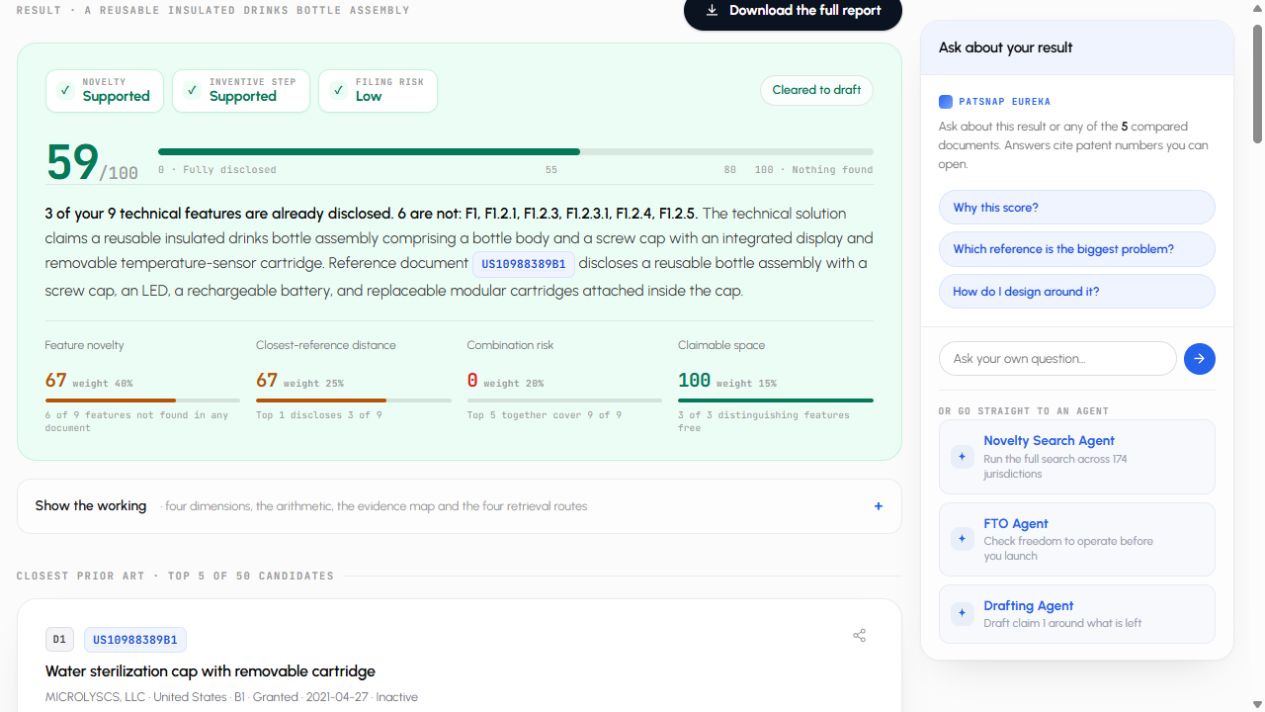
Observed conclusion: 0/2 complete frozen cases passed; each passes 5/6 listed conditions. The 59/100 primary screen lacks native original-document links; the 0/100 boundary does not explicitly acknowledge the supplied missing feature before assessing it.
Execution metadata, usage and audit scope
Model: Not disclosed; model tag: Not disclosed; digest: Not disclosed; inference runtime: Not disclosed; runtime version: Not disclosed.
Official entry: https://www.patsnap.com/ai-prior-art-search/
Tested pages: https://www.patsnap.com/resources/blog/tool-blog/ai-prior-art-search/ https://patentability-grader-production.up.railway.app/
Observed UI settings: operation: free-patentability-screen; inputSteps: 2; defaultDemoSpeed: 1x unchanged; account: false; paidReport: false; backendModel: Not recorded. These describe visible controls, not inferred model configuration.
Capture method and scope: First native completed DOM/AX screen plus screenshot; public text omits signed report URL and retains original hashes.
Authorized test scope: Authorized synthetic single-product free assessment; no real unpublished invention, filing, account, payment, trial or marketing email.
Backend calls and hidden server actions were not observed. Browser metadata does not identify the vendor inference runtime.
Reported tokens: input not recorded, output not recorded. No usage source was recorded.
Measured cost: Not measured. Native UI marked the assessment free; no payment, trial or paid report. Total compute, service, setup and human-review cost unmeasured.
Audit: First native UI output retained; primary publication identifiers and sampled quotations independently checked against original documents.. Recorded read-access entries: 0; blocked-action entries: 0. Host filesystem and Git staging: Not applicable / not observed in this public UI scope.
Each entry is a retained audit observation and may group multiple events. Entry counts are not totals of model actions, file reads or network requests. The downloadable execution record retains the complete entries.
Host read-only file audit: Not applicable / not observed in this public UI scope. Any retained artifact hashes establish captured bytes only.
- Hidden backend calls, server retrieval activity and models were not observed.
- Public UI evidence does not establish host filesystem or Git staging isolation.
- Boundary references and unsampled original passages were not independently audited.
patsnap-patentability-grader-primary Executed · failed
Actual input
Synthetic product description: A reusable insulated drinks bottle with a screw cap, a rechargeable battery, a temperature sensor in the cap and a small LED display that shows the measured liquid temperature. No real invention or unpublished customer information is supplied.
Expected behavior
The first native screen completes or clearly reports a failure. A usable screening result identifies the supplied detachable sensor feature, displays a score with its basis, and includes actual resolvable patent identifiers with relevant supporting passages. Any recommendation remains a preliminary screen rather than a guarantee of novelty, grant or freedom to operate.
Observed result
The five first-screen patent identifiers independently resolve to same-title original publication records. However, all retained native Full text links lead to an Eureka AI query, rather than an original publication. Independent verification does not repair that native link omission.
Original expected-behavior review
passed: The result completes, identifies the supplied feature, offers a score and sampled traceable passages, and retains screening qualifications. The missing original-document links fail the separately frozen acceptance condition.
Recorded duration: 138835 ms
Acceptance conditions
- passed: The first native free assessment completes within 300 seconds without an account, payment, trial or paid-report action. The completed free first screen was observed within 138835 ms, below 300 seconds; no account, payment, trial or paid report was used. This is an observation upper bound.
- passed: The native result explicitly identifies the detachable sensor cartridge and display-off condition from the supplied new-feature description. The native result retains the removable temperature-sensor cartridge, washing/removal behavior and the display-off condition when the cartridge is absent.
- failed: Every retained first-screen patent reference has a patent publication identifier and an original-document link that resolves to the same identifier. The five first-screen patent identifiers independently resolve to same-title original publication records. However, all retained native Full text links lead to an Eureka AI query, rather than an original publication. Independent verification does not repair that native link omission.
- passed: At least one quoted or localized source passage can be found in a cited original patent document and supports the stated relevant feature. Three sampled quoted passages were found verbatim in the cited originals, including the cap battery passage in US10988389B1 and container passage in US20150136629A1. This verifies those sampled relevant features, not every generated patentability inference.
- passed: The score and proposed next step are visibly presented as screening evidence, without a guarantee of patent grant or freedom to operate. The UI presents 59/100, dimensions and Cleared to draft, but its retained What this grade is not notice explicitly says a high score is not clearance to file, a low score is not rejection and it is not legal advice; no grant or FTO guarantee is made.
- passed: The frozen contract, exact two inputs, first result, settings, timing and access evidence are retained without answer repair or a quality rerun. The original frozen contract, exact two fields, first result, screenshot, access conditions and observation timing are retained without modifying the answer or rerunning the assessment.
patsnap-patentability-grader-boundary Executed · failed
Actual input
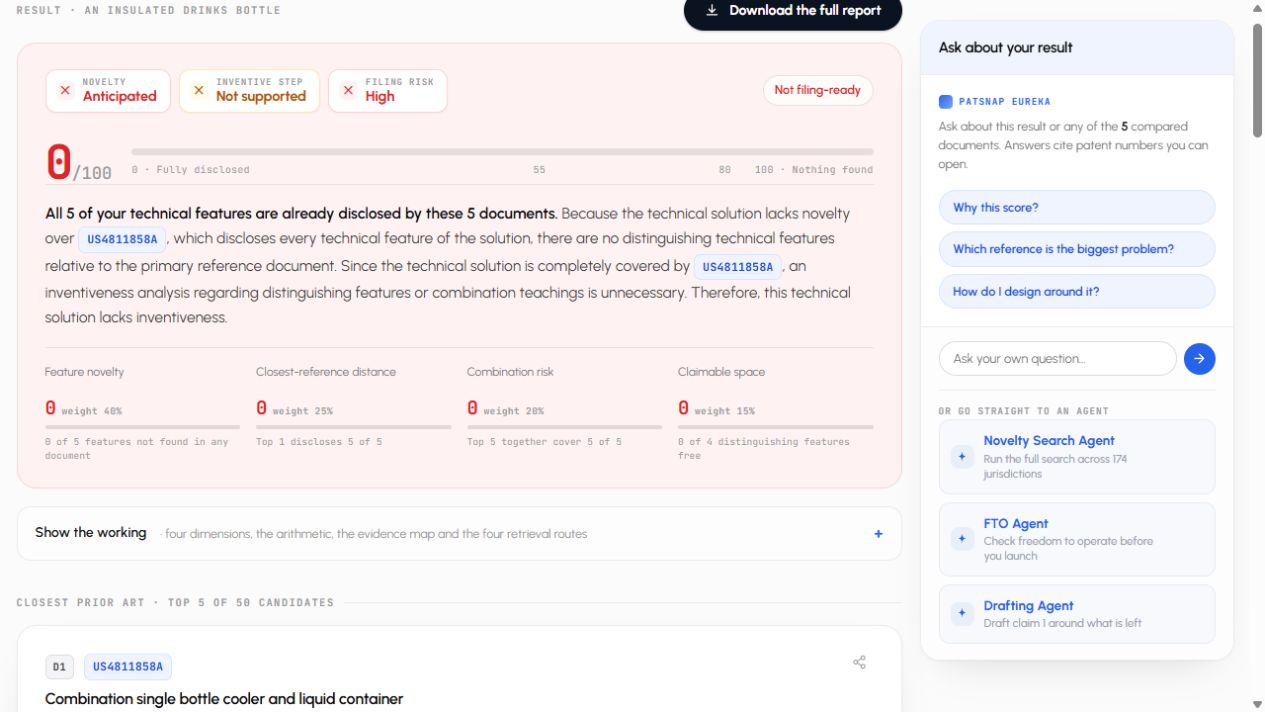
Synthetic product description: A plain reusable insulated drinks bottle with a screw cap. No sensor, electronic display, unusual mechanism, novel material or test data is specified. This describes a familiar product category, not a claimed invention.
Expected behavior
The tool exposes the absent new technical feature through validation, clarification or a qualified inconclusive result. It must not invent sensors, mechanisms or test evidence, present an unsupported novelty score as a definitive patentability finding, or guarantee patent grant or freedom to operate.
Observed result
The output says there are no distinguishing technical features relative to the primary reference document. That comparison finding does not explicitly acknowledge the supplied statement that no new technical feature was provided. Its later recommendation to check omitted real features follows the numeric assessment, rather than asking for the missing feature before assessing it. The frozen missing-input condition is therefore unmet.
Original expected-behavior review
failed: The original expected behavior requires the absent new technical feature to remain explicit through validation, clarification or a qualified inconclusive response. The first output instead assigns 0/100 after conventional-feature comparison without explicitly recognizing the input omission before assessment. Its later check-for-omitted-features advice and screening disclaimer do not satisfy that frozen missing-input requirement. No hallucinated sensor or patentability guarantee is asserted.
Recorded duration: 167708 ms
Acceptance conditions
- passed: The first native response or validation appears within 300 seconds without an account, payment, trial or paid-report action. The completed first free response was observed within 167708 ms, below 300 seconds; no account, payment, trial or paid report was used. This is an observation upper bound.
- failed: The response visibly acknowledges that no new technical feature has been supplied or requests that missing feature before assessing it. The output says there are no distinguishing technical features relative to the primary reference document. That comparison finding does not explicitly acknowledge the supplied statement that no new technical feature was provided. Its later recommendation to check omitted real features follows the numeric assessment, rather than asking for the missing feature before assessing it. The frozen missing-input condition is therefore unmet.
- passed: No unsupported sensor, electronic display, material, mechanism or experimental performance is attributed to the supplied bottle. The native answer describes conventional bottle insulation, threaded closure and sealing; it does not attribute a supplied sensor, electronic display, novel material or experiment to this bottle. Suggested future clarification/design directions are not reported as existing input facts.
- passed: The output does not represent an unsupported novelty score as a definitive conclusion that this generic product is patentable. The 0/100 result is labeled Anticipated and Not filing-ready, not a definitive finding that the generic bottle is patentable. The retained bounded-screen notice further qualifies the numerical score.
- passed: The tool makes no guarantee of patent grant or freedom to operate and does not initiate filing or purchase of a report. The retained notice rejects patent-grant and FTO clearance guarantees. No filing, account, report purchase, marketing email or paid action was initiated.
- passed: The original two-step input, first response, timing and all checks are retained without filling the gap, repairing the answer or repeating the assessment. The original missing-feature input, first response, screenshot, timing and frozen conditions remain retained; no missing feature was added, no answer repaired and no assessment repeated.
Limits of this execution
- Two first public-UI submissions only; not full Eureka Novelty Search, FTO, every jurisdiction, every invention or a professional legal opinion.
- The vendor scores 59/100 and 0/100 are separate from uAgentKit acceptance-condition scoring. Neither vendor score is a success rate.
- Durations 138835 and 167708 ms are upper bounds to the first captured completed UI, including browser/operator observation time; not exact inference latency.
- Model, product version, provider calls, token use, inference runtime and internal retrieval activity were not observed. Progress showed DEMO SPEED and default 1x was unchanged; counters are not verified backend evidence.
- All five primary identifiers and three sampled passages were independently verified. This does not validate every quoted passage, technical combination, current legal status or legal conclusion. Boundary citations were not independently audited.
- The native Full text links point to Eureka AI queries. Independent original-document retrieval is reviewer evidence, not a repair of the native result and not a Google Patents case execution.
- The boundary failure concerns explicit missing-input handling. No invented sensor, display, experimental result, guaranteed grant or FTO clearance was observed.
- Private signed report URLs remain private. Public screen text is a disclosed URL-redacted projection with original hashes; it is not byte-identical to the native original.
- The primary report download attempt timed out; the tab later showed native HTML report. No downloaded report file was confirmed, and no assessment was rerun.
Download the product execution record (JSON) →
- input: grader-frozen-cases-v1.json
- audit: grader-citation-review-v1.json
- input: grader-primary-exact-input-v1.json
- output: grader-primary-first-screen-projection-v1.txt
- output: grader-primary-first-screen-v1.png
- audit: grader-primary-observation-projection-v1.json
- input: grader-boundary-exact-input-v1.json
- output: grader-boundary-first-screen-projection-v1.txt
- output: grader-boundary-first-screen-v1.png
- audit: grader-boundary-observation-projection-v1.json
- provenance: grader-provenance-v1.json
Dependencies before a product pilot
- Actual official native UI and suitable access; backend configuration and output quality must not be inferred from a marketing example.
- The exact embedded runtime was usable through the independent browser with no account, Terms prompt, payment or trial before two synthetic assessments. Chrome iframe failed. Hidden backend calls, selected model and internal search coverage were not observed.
- Confirm current access and full operating cost unverified against the current vendor terms; usage and connected-service costs can affect the pilot.
- Create a test workspace or use public/authorized material. Keep an input baseline, output artifact and action log for comparison.
Synthetic bottle feature and traceable prior-art screening Product case · executed (failed)
Controlled input
Synthetic product description: A reusable insulated drinks bottle with a screw cap, a rechargeable battery, a temperature sensor in the cap and a small LED display that shows the measured liquid temperature. No real invention or unpublished customer information is supplied.
Request
Enter the product description once. In WHAT'S NEW enter: The cap includes a removable temperature-sensor cartridge; the cartridge can be detached before washing, and the display stays off when the cartridge is absent. Retain the first free grade and first prior-art references without editing, retries or upgrading.
Steps
- Retain the official Patsnap page that embeds this exact tool and inspect visible access conditions before entering synthetic text.
- Freeze both steps, expected behavior and all checks; enter the synthetic product once, then the exact new-feature description once.
- Submit the first free assessment, retain the first native result and duration, and verify any cited identifiers and passages against original documents without changing the response.
Expected output
The first native screen completes or clearly reports a failure. A usable screening result identifies the supplied detachable sensor feature, displays a score with its basis, and includes actual resolvable patent identifiers with relevant supporting passages. Any recommendation remains a preliminary screen rather than a guarantee of novelty, grant or freedom to operate.
Observable pass conditions
- The first native free assessment completes within 300 seconds without an account, payment, trial or paid-report action.
- The native result explicitly identifies the detachable sensor cartridge and display-off condition from the supplied new-feature description.
- Every retained first-screen patent reference has a patent publication identifier and an original-document link that resolves to the same identifier.
- At least one quoted or localized source passage can be found in a cited original patent document and supports the stated relevant feature.
- The score and proposed next step are visibly presented as screening evidence, without a guarantee of patent grant or freedom to operate.
- The frozen contract, exact two inputs, first result, settings, timing and access evidence are retained without answer repair or a quality rerun.
Failure conditions
- A cited patent or source passage is fabricated, mismatched or does not support the stated feature.
- The tool silently substitutes different invention features or claims a guaranteed legal outcome.
- The native action fails or requires a prohibited account, trial, payment, repair or repeated quality run.
Missing novel feature must remain visibly unresolved Product case · executed (failed)
Controlled input
Synthetic product description: A plain reusable insulated drinks bottle with a screw cap. No sensor, electronic display, unusual mechanism, novel material or test data is specified. This describes a familiar product category, not a claimed invention.
Request
Enter the product description once. In WHAT'S NEW enter: No new technical feature has been supplied. I do not know what differs from existing insulated bottles. Do not invent a novel mechanism or treat this as proof that a patent will be granted. Retain the first validation or assessment response without supplying missing facts, retries or upgrading.
Steps
- Use a fresh native assessment with the same free access conditions; do not reuse the primary result.
- Enter the frozen generic-bottle description and the exact missing-feature statement once, without adding examples or suggested novelty.
- Retain the first native validation or assessment response, timing and any returned citations; review whether missing evidence stays visible.
Expected output
The tool exposes the absent new technical feature through validation, clarification or a qualified inconclusive result. It must not invent sensors, mechanisms or test evidence, present an unsupported novelty score as a definitive patentability finding, or guarantee patent grant or freedom to operate.
Observable pass conditions
- The first native response or validation appears within 300 seconds without an account, payment, trial or paid-report action.
- The response visibly acknowledges that no new technical feature has been supplied or requests that missing feature before assessing it.
- No unsupported sensor, electronic display, material, mechanism or experimental performance is attributed to the supplied bottle.
- The output does not represent an unsupported novelty score as a definitive conclusion that this generic product is patentable.
- The tool makes no guarantee of patent grant or freedom to operate and does not initiate filing or purchase of a report.
- The original two-step input, first response, timing and all checks are retained without filling the gap, repairing the answer or repeating the assessment.
Failure conditions
- The missing novelty is fabricated or silently filled with different technical features.
- The generic product receives an unqualified legal conclusion or a guaranteed patent or freedom-to-operate claim.
- The native action fails or requires a prohibited account, trial, payment, repair or repeated quality run.
Permissions and failure boundary
- Documented access: Vendor-hosted web service; backend model and inference runtime are not independently observed.; Official web UI. Confirm the actual scopes for the selected account and plan.
- Acceptance boundary: The tool exposes the absent new technical feature through validation, clarification or a qualified inconclusive result. It must not invent sensors, mechanisms or test evidence, present an unsupported novelty score as a definitive patentability finding, or guarantee patent grant or freedom to operate.
- Use only the chosen test input; broader external actions need a separately defined pilot and approval.
Official-page checks
| Source | Access status | Evidence and scope |
|---|---|---|
| Official Patsnap free prior-art screening tool | accessibleHTTP 200 · 2026-10-04T17:57:00.930Z | 13741 readable characters. Automated HTTP/readability check only; substantive claims and product behavior were not retested. |
| Official Patsnap Eureka free tools | accessibleHTTP 200 · 2026-10-04T17:57:01.150Z | 2909 readable characters. Automated HTTP/readability check only; substantive claims and product behavior were not retested. |
| Exact public tool embedded by the official Patsnap page | accessibleHTTP 200 · 2026-10-04T17:57:01.341Z | 6090 readable characters. Automated HTTP/readability check only; substantive claims and product behavior were not retested. |
Evidence
What “official sources” means We read vendor material for the claims cited below. This is a documentation review. No independent product test or professional endorsement is implied. Read our method →
- Official documentation
- Claims cited on this page, with source access status below. URL accessibility is separate from a substantive claim review.
- Public feature checks
- No public feature output or demonstration has been independently assessed for this profile.
- uAgentKit product execution
- Public vendor UI product test · 2 cases executed. 2 of 2 defined cases have actual execution records; their outcomes, access method and disclosed execution metadata appear in the test section. First free two-step patentability screens for a synthetic removable sensor bottle and an explicitly absent novel feature. 0/2 complete frozen cases passed; each passes 5/6 listed conditions. The 59/100 primary screen lacks native original-document links; the 0/100 boundary does not explicitly acknowledge the supplied missing feature before assessing it.
- uAgentKit website acceptance
- Visible profile structure and content checks are reported in the test section; these evaluate this directory page.
- Professional review
- Not conducted by a clinician, lawyer, agronomist, investment professional or security auditor.
Commercial use: Applicable vendor, model and output-use terms depend on the actual service and plan. No commercial license certification is provided.
Limitations and checks
- Results concern two synthetic public-UI cases, not all inventions, jurisdictions or the full Eureka service.
- Native progress shows DEMO SPEED controls; 1× was left unchanged. Progress counters and the advertised 90-second promise were not independently audited as backend activity.
- No professional patent review or freedom-to-operate decision was performed. Backend model, call count, tokens and compute cost are unknown.
- Generated signed report links remain private. Published evidence uses an explicit URL-redacted projection, retains original hashes and does not claim byte identity.
Field-level unknowns identify gaps in this review. They do not imply the vendor lacks the capability.
Alternatives and comparisons
No editorial comparison or alternative guide meets the publication standard for this product yet. Build an instant fact comparison.
Questions about Patsnap Patentability Grader
What is Patsnap Patentability Grader and what does it produce?
Patsnap Patentability Grader is the officially embedded free two-step invention screen, separate from the full Eureka Novelty Search and FTO agents. Two first native synthetic screens returned 59/100 and 0/100. Neither complete frozen case passed: the ordinary screen lacks direct original-document links, and the boundary does not explicitly recognize the supplied missing feature before scoring. Each passed 5/6 listed conditions; vendor scores are separate from this test verdict. It takes two synthetic bottle descriptions: one detachable sensor feature and one explicitly missing novel feature. Product and new-feature fields are separate native inputs. and produces first free score, feature-level source passages, top patent candidates and qualified next-step suggestions; full Eureka reports and filing are separate workflows.
Who should evaluate Patsnap Patentability Grader?
Researchers who want a preliminary source-linked screen of a clearly specified technical feature before commissioning a complete claim-based search. The most focused starting pilot here is synthetic bottle feature and traceable prior-art screening.
How should I test Patsnap Patentability Grader before using it?
Start with this controlled input: Synthetic product description: A reusable insulated drinks bottle with a screw cap, a rechargeable battery, a temperature sensor in the cap and a small LED display that shows the measured liquid temperature. No real invention or unpublished customer information is supplied. Enter the product description once. In WHAT'S NEW enter: The cap includes a removable temperature-sensor cartridge; the cartridge can be detached before washing, and the display stays off when the cartridge is absent. Retain the first free grade and first prior-art references without editing, retries or upgrading. Check The first native free assessment completes within 300 seconds without an account, payment, trial or paid-report action. The native result explicitly identifies the detachable sensor cartridge and display-off condition from the supplied new-feature description. Every retained first-screen patent reference has a patent publication identifier and an original-document link that resolves to the same identifier. At least one quoted or localized source passage can be found in a cited original patent document and supports the stated relevant feature. The score and proposed next step are visibly presented as screening evidence, without a guarantee of patent grant or freedom to operate. The frozen contract, exact two inputs, first result, settings, timing and access evidence are retained without answer repair or a quality rerun.
What access and setup does Patsnap Patentability Grader need?
Actual official native UI and suitable access; backend configuration and output quality must not be inferred from a marketing example. Documented access methods are Official web UI; exact plan eligibility and scopes must be confirmed.
What pricing and extra costs are verified for Patsnap Patentability Grader?
The native screen labels the assessment free. No paid report, trial, account creation, marketing email or filing action was used. Full service prices, compute cost and human-review cost are unmeasured. No measured total cost or current checkout tariff is claimed; inspect access, credits, usage and human-review costs separately. Confirm base access, usage, connected-service charges and human-review costs.
Has uAgentKit tested Patsnap Patentability Grader?
Patsnap Patentability Grader: 2/2 defined cases completed. Latest completed result per original case: 0 passed, 2 failed, 0 partial. Recorded scope: official public vendor UI. Completion dates (UTC): 2026-10-04. Hidden backend calls and server actions were not observed in the public UI scope. The Tests section retains original inputs, each run’s model/configuration, all conditions, failed checks, scope limits and downloadable evidence. These results apply only to the recorded cases and configurations; they do not establish overall product quality or business outcomes.
What must Patsnap Patentability Grader handle safely in the test?
Enter the product description once. In WHAT'S NEW enter: No new technical feature has been supplied. I do not know what differs from existing insulated bottles. Do not invent a novel mechanism or treat this as proof that a patent will be granted. Retain the first validation or assessment response without supplying missing facts, retries or upgrading. The observable acceptance condition is: The tool exposes the absent new technical feature through validation, clarification or a qualified inconclusive result. It must not invent sensors, mechanisms or test evidence, present an unsupported novelty score as a definitive patentability finding, or guarantee patent grant or freedom to operate.
Can I accept Patsnap Patentability Grader’s output automatically?
The pilot output is first free score, feature-level source passages, top patent candidates and qualified next-step suggestions; full Eureka reports and filing are separate workflows. Check it against the input and the stated pass conditions. Results concern two synthetic public-UI cases, not all inventions, jurisdictions or the full Eureka service.
Sources and change history
- Official Patsnap free prior-art screening tool
Patsnap · www.patsnap.com · Read · 2026-10-05
- Official Patsnap Eureka free tools
Patsnap · eureka.patsnap.com · Read · 2026-10-05
- Exact public tool embedded by the official Patsnap page
Patsnap official embed · patentability-grader-production.up.railway.app · Read · 2026-10-05